‘Writing is a Democratic Activity’: How Joyce Carol Oates Inspired a KC Novelist to Teach
This article first ran in The Kansas City Star on October 25, 2026.
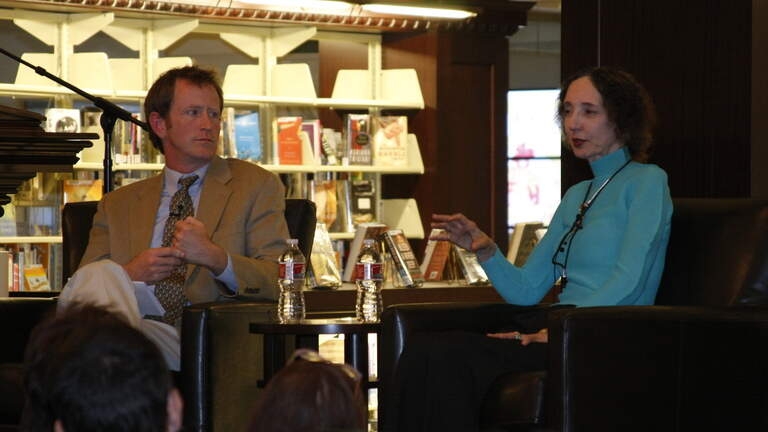
This year's Writers for Readers fundraising banquet on Friday, November 20, features Joyce Carol Oates, who will discuss her career and her two most recent books with Whitney Terrell.
Novelist Whitney Terrell says that writing is a democratic activity; it’s open to everyone. He’s thinking of his students. He’s thinking of his students’ students. And he’s also thinking of his friend and former teacher, novelist Joyce Carol Oates.
All of these writers, new, beginner, and superstar, form what he thinks of as a coaching tree, like in soccer or football. And it’s unlikely that they’d have easy access to the publishing world.
Of course, Oates has that access now. She’s been a prolific and award-winning writer for decades. But her unglamorous upbringing in western New York didn’t position her for success in any traditional sense.
Terrell said, “She got a scholarship, went to Syracuse University and made herself into a writer. And that is what students at UMKC are trying to do.”
The notions of a coaching tree and writing being open to everyone are in answer to Terrell’s own experience growing up in Kansas City as an aspiring writer.
“I didn’t know anyone who had published a book with a national press. The only writer that I knew was Charles Gusewelle, whose daughter I went to school with,” Terrell said. “He was a columnist at The Star and was very well known in the city, but not very well known outside of the city.”
Terrell later studied under greats like Oates and James Allen McPherson in world-renowned writing programs at Princeton University and the University of Iowa and has published three novels, most recently The Good Lieutenant. He and his similarly educated colleagues at the University of Missouri-Kansas City pass their knowledge to students in the Master of Fine Arts in Creative Writing & Media Arts program.
Then, through a program called Writers for Readers, those students teach free writing classes to the public at Kansas City Public Library locations.
The graduate students receive some scholarship money, and those who attend classes at the Library become limbs on the coaching tree.
“A library is a place for democratic learning,” Terrell said, “where anybody can walk in the door and learn anything that they want. And so, to me, it’s very exciting, and we’re thrilled that the library’s offered us that opportunity and has supported that program.”
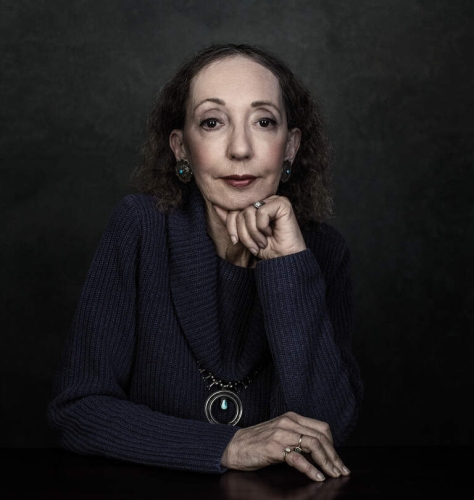
Oates’ work spans genres and includes the short story “Where Are You Going, Where Have You Been?” and the novel Blonde, both of which have been adapted into films. She’s been awarded the National Humanities Medal, the National Book Award, several lifetime achievement awards, and other honors.
Terrell said that he thinks Midwesterners often view achieving even a fraction of what Oates has as “an incredibly distant and bewildering prospect.”
But, he explained, it shouldn’t be — especially in Kansas City’s current literary landscape.
“This person taught me. I’m teaching you,” Terrell said. “You can do the same thing that I did or that this person did, you know? You can have this if you want.”
On November 20 at UMKC’s Student Union, Terrell will talk to Oates about her legacy and her most recent books, The Frenzy and Fox, during a banquet fundraiser for the Writers for Readers program he founded with the Kansas City Public Library years ago. The annual banquet funds the free writing classes at the Library. Purchase tickets here.
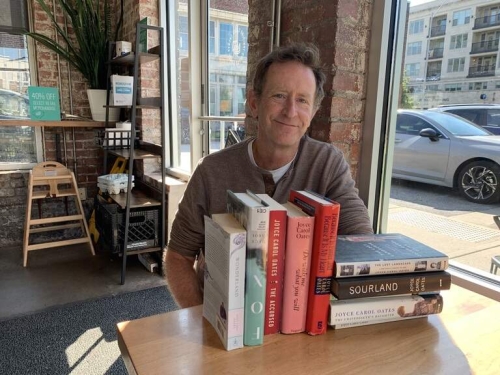
In anticipation of that conversation, he pulled several of her books from his shelves — with nearly 200 published works, he wanted to refresh his memory and offer newcomers a starting place.
He recommended these with the following comments:
- Wonderland 1971 This book is part of the Wonderland Quartet and is Joyce thinking about identity, thinking about the conflict between American ideals.
- On Boxing 1987 People were surprised that a woman would write about boxing, but of course Joyce would love boxing. It has all of the elements. It’s gothic. It has violence. It has storytelling.
- Because it is Bitter, and Because it is My Heart 1990 It’s basically about a romance between a white girl and a Black man and a murder that is connected to it. It’s an unflinching, incredibly smart, really beautifully written novel.
- Nemesis 1990 This one is about a very controversial sexual harassment issue that happened at Princeton. I appreciated her ability and willingness to take controversial issues, things that might make her administration upset or angry or other professors and turn them into fiction and confront difficult issues head on.
- We Were the Mulvaneys 1996 People did not write about sexual assault and it is now common, but that is in part because of what Joyce Carol Oates did as a writer: breaking that ground and opening up those silences.
- The Gravedigger’s Daughter 2007 Joyce had a grandmother who was Jewish, and so this is talking about anti-Semitism and Jewish immigration into America, so that’s another facet of her writing that I think is worth noting and thinking about.
- The Journal of Joyce Carol Oates: 1973-1982 2007 Joyce gave up writing in her journal at some point to write on Twitter (X). But all of her earlier journals before Twitter existed are amazing. I say that Joyce came from nothing, but she is also now in her adult career incredibly well connected, and she’s communicated with and thought about and talked to and written letters with all of the major writers of the 20th and 21st century.
- Wild Nights! 2008 There are incredibly playful and interesting stories that are connected to historic writers, and it’s just Joyce having fun. “Sourland” 2010 This is what she talked about the last time she came to Kansas City in 2011. It was the first, or close to the first, collection of stories that came out after her first husband died.
- The Accursed 2013 It’s set at Princeton during Woodrow Wilson’s time. It’s got vampires, but it’s also really an accounting of how racist Woodrow Wilson was, and no one had really written about that in fiction.
- The Man Without a Shadow 2016 That’s a book about memory loss and identity and was important to me because my grandmother had short-term memory loss. It’s about what it is like to have a relationship with someone who can’t remember you.
Buy a ticket to the Writers for Readers event on Friday, November 20, 2026, at 6 p.m.